

Looking for the ultimate English to Russian translation service?
In this article, I’ll review three translator apps that are most popular and free.
I’ll also give practical advice about machine translation (MT) pitfalls you want to avoid.
Contestant #1: Yandex Translate

Yandex is a Russian company similar to Google, providing services such as online search, maps, context ads, a cloud drive, and so on, mainly focused on Russian-speaking users.
With the Russian language at the core of its business, Yandex is presumably in a good position to provide machine translations from and into Russian, potentially even better than Google.
Translation is available as an online Russian translation service. You can also install an app called Yandex.Translate to use both as an online or offline translator.
Contestant #2: Google Translate

Given the global reach of Google, it’s probably the number one translation app.
Relying on Google’s massive computing resources and AI advancements, it has the power to provide good translations in a flash of a second.
Available both as an online translation service and a smartphone app, Google Translate.
Contestant #3: Reverso

Going beyond translation, Reverso offers tools for learning new words and understanding language nuances by providing examples of real-world usage of words.
But hypothetically, it should be less powerful than Yandex or Google, because it has just a fraction of their computing power.
Available both as an online translation service and a smartphone app, Reverso Translation Dictionary.
To give you an idea of what kind of quality you should expect from these Russian translator apps, I challenged them with several translations of various difficulty.
Sentence #1: “Free machine translation services have become better in the last five years”
Let’s evaluate translations for accuracy and readability on a scale from 1 to 10.
Yandex’s output

Accuracy: 10/10. Yandex handled the easiest sentence in the test test extremely well. Hey, I’m not even sure every human translator can do this well, judging by the average quality of translations I see.
Readability: 10/10.
Google’s output

Accuracy: 9/10. Google did well, too. Surprisingly, though, it omitted “machine,” which makes the translation ambiguous. “Free translator services” might mean both machine and human translators, whereas the original talks just about the former.
Readability: 9/10. Google’s rendering of “services” is slightly worse than the Yandex’s.
Note also that Google shows you a transliterated version of the text, which might also come in handy when you need transliteration.
Reverso’s output

Accuracy: 5/10. Reverso mistranslated the ambiguous word “free” as “свободные” (as in “free market”).
Readability: 5/10. “В последних пяти годах” doesn’t sound right. Coupled with the mistranslation, this has a major impact on readability.
What’s unique about Reverso is fuzzy matching your query with its translation memories. You get a list of “original plus translation” pairs that include parts of your query.
In this example, Reverso was able to match 3 to 4 words with TM entries. These suggestions give you ideas for improving the translation as well as help you learn languages, which is Reverso’s mission.
Sentence #2: “The System is considered a life-sustaining medical device and must be tracked per foreign regulatory agency regulations”
Yandex’s output
Yandex showed weird behavior. The entire sentence produced this gibberish:

It makes no sense whatsoever.
I played with this sentence a little bit and found that removing the word “regulations” results in a much better translation. It appears that Yandex Translate may withhold from using advanced MT technology such as neural networks, limiting the output to crude translations.
This is the better version I got:

Accuracy: 5/10. Pretty accurate overall. But a major mistranslation unfolded out of thin air: “life-sustaining” is translated as “vital,” shifting the focus from patients’ lives to the life of the device itself.
Readability: 9/10. The translation reads quite well and appears credible, disguising the mistranslation—a problem that plagues translators! A sentence might make perfect sense to you, while the original actually meant something completely different!
Google’s output

Accuracy: 8/10. Google is hands down better in terms of accuracy (well, anyone would be, with such a blooper from Yandex). But it omitted a word again! Now, “foreign” is missing.
Readability: 9/10. I only frowned at the wording “система… должна отслеживаться,” just as with the Yandex’s translation.
Reverso’s output

Accuracy: 3/10. It feels like Reverso didn’t even try this time. “Life-sustaining” is translated as a standalone noun incoherent with the rest of the text. “Foreign regulatory agency regulations” is rendered as “foreign regulations of a regulatory agency.”
Readability: 1/10. As if the accuracy issues weren’t enough, Reverso throws in a couple of grammar bloopers: “Считается… медицинское устройство” and “прослежено… за правила.”
Sentence #3: “Stimulator module can be turned off by setting the frequency of the selected stimulation channel with the lowest number to zero”
Now, let’s play with more specialized examples. For starters, I’ve picked this rather simple sentence with a little technical twist.
Yandex’s output
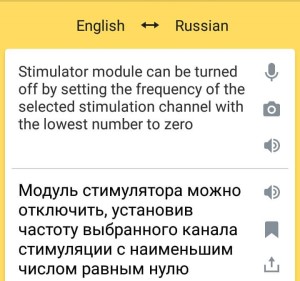
Accuracy: 5/10. Yandex messed up the last portion of the sentence, making it appear as if the lowest number is zero.
Readability: 8/10. Aside from this blunder, the translation reads well.
Google’s output

Accuracy: 10/10. Bravo! Again, Google did just as well as a professional Russian translator would.
Readability: 9/10. I’d only pick on “установив частоту… до нуля.” “на ноль” would sound better.
Reverso’s output
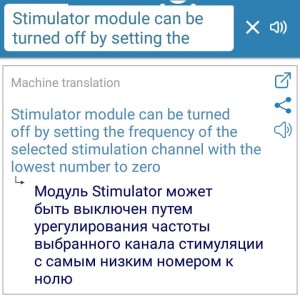
Accuracy: 5/10. “Stimulator” is left untranslated. Otherwise, the translation is more or less comprehensible. Still, you can already see that Reverso starts to lag behind the other two contestants.
Readability: 3/10. “Урегулирования частоты… к нолю” and “низким номером” don’t sound right.
Sentence #4: “25 subjects were exposed to the study drug as a single agent; 12 subjects received the drug as part of a combination or cross-over regimen; 13 subjects received blinded-therapy”
TechEmergence published a chart from Google that promises MT quality close to human translation. Let’s see how true this promise is for English to Russian translation. This sentence is packed with medical terms to put additional pressure on MT.
Yandex’s output

Accuracy: 10/10. No objections.
Readability: 8/10. “подвергались воздействию” and “слепую терапию” could use some improvement.
Google’s output
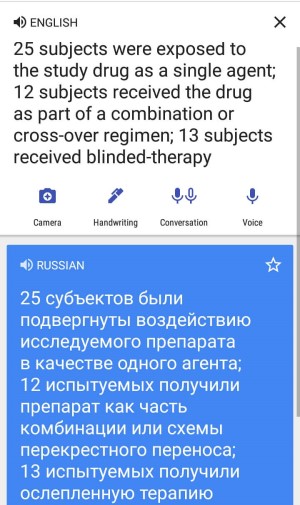
Accuracy: 9/10. The translation of “cross-over regimen” is questionable. It’s simply too literal to make sense.
Readability: 7/10. “в качестве одного агента” and ”часть комбинации” sound robotic. “Subjects” are translated inconsistently, making the reader raise their brow.
Reverso’s output

Accuracy: 1/10. Reverso failed miserably with this one: from translating “subject” as “topic” to rendering “blinded-therapy” as “with you blind therapy.”
Readability: 1/10. The translation feels like a classic MT blooper. Translators used to generate this type of translations just to make fun of MT back in the day.
Sentence #5: “With simultaneous bilateral knee surgery, release leg tourniquets ten minutes apart to lessen any lung insult that may occur”
This is a specialized sentence requiring deeper thought. It’s an example of critical communications explained by Preciso that professional translators are paid to translate.
Yandex’s output
As I worked on testing this sentence, I reviewed the result that Yandex had given me. But when I ran this sentence through Yandex again a few days later, it gave me gibberish instead of the first version:

It’s the second time when Yandex produces a translation that doesn’t make any sense. I’ll use the first version anyway:
[su_quote]При одновременной двусторонней операции на колене отпустите турникеты ног на десять минут друг от друга, чтобы уменьшить любое оскорбление легких, которое может произойти.[/su_quote]
Accuracy: 3/10. Yandex got all the three main challenges wrong.
“Bilateral knee surgery” is translated word-for-word, whereas the correct translation is “surgery on both knees.”
“Release leg tourniquets ten minutes apart” is completely mistranslated: “move the tourniquets away from each other for ten minutes,” whereas what’s meant is “releasing the tourniquet from one leg and taking 10 minutes before releasing the tourniquet from the other leg.”
“Finally”, “lung insult” is translated as “treating lungs with disrespect.”
Readability: 8/10. The sentence reads well, but it’s totally wrong. I’d rather have it backwards.
Google’s output

Accuracy: 3/10. Google didn’t go beyond word-for-word translation either, letting the ambiguous portions of text backfire.
Readability: 8/10. The same result as with the Yandex’s translation.
Reverso’s output

Accuracy: 1/10. Another useless translation from Reverso. It did no better than the other two contestants in terms of meaning.
Readability: 1/10. But from the style perspective, things are even worse. Take the unnecessary comma or clashing perfective and imperfective verbs (“выпустите… чтобы уменьшать”).
Sentence #6: “We all have an impact and a role in connecting people to work in ways that enrich their lives”
Now, let’s have the contestants tackle a more creative piece of text. This is the most difficult type of translation for machine translators, because they have a hard time going beyond the face value of words. According to thoughts on machine translation by Creative Words, marketing content should always be left to the inspiration of a translator.
Yandex’s output

Accuracy: 6/10. The main challenge here is the ambiguous part: “connecting people to work.” On the surface, it might be understood as “bringing people to work together,” whereas the author meant “assigning people to jobs.” Yandex went for the word-for-word translation, but in a “soft” way—you can still get a general idea of the author’s message—it’s something about helping people work.
Readability: 7/10. The translation reads well overall. The only major blooper is “свою жизнь.” It means “our lives ” instead of “their lives”. Another incoherence is a wrong preposition in “влияние… в объединении.”
Google’s output
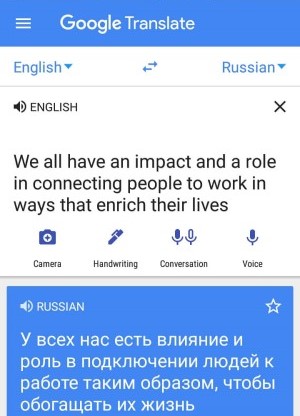
Accuracy: 9/10. Google did better than Yandex, translating the “connecting people to work” part correctly.
Readability: 8/10. Unlike Yandex, Google got the “their lives” part correct. And the grammar incoherence (“влияние… в подключении” ) is still present.
Reverso’s output
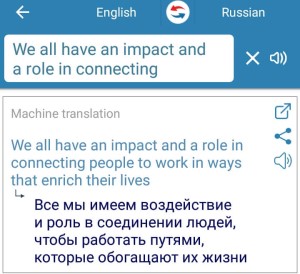
Accuracy: 2/10. Not only did Reverso fail to handle the challenging piece correctly, but it produced a more vague sentence overall, too.
Readability: 2/10. Reverso exacerbated the grammar incoherence seen in the previous two translations: “воздействие… в соединении,” making it sound 100% robotic. Another stylistic blooper is “работать путями, которые обогащают.”
Sentence #7: an error in the source text
Finally, let’s see how these services tackle a sentence with an error. English texts can be imperfect, which is something a human Russian translator can spot easily. But what about machines?
I started by testing a simple sentence, “This medication is for tropical administration only.” “Tropical” should be “topical” here.
Both Yandex and Google corrected the error on the fly, i.e, without even asking me for help. Impressive! Turns out the intelligence behind these services is already able to spots tricky misspellings.
Our underdog, Reverso, failed to correct the error.
Let’s crank it up another notch and test an error less obvious to a machine translator:
“Lift the left side of the crate and only after it is in the air, lift the left side.”
Yandex’s output

Accuracy: 3/10. Not only did Yandex fail to correct the “left and left” error, but it also made a major mistranslation, assuming “it is in the air” refers to the entire crate. It appears that after you lift the left side, you need to wait until the entire crate is in the air. Which makes no sense.
Readability: 10/10. As we’ve seen before, Yandex is very good at producing readable translations for simple sentences.
Google’s output

Accuracy: 6/10. Although Google didn’t question the “left and left” error either, it understood that “it is in the air” refers to just the side, but not the entire crate, outperforming Yandex.
Readability: 10/10. Well done, Google.
Reverso’s output
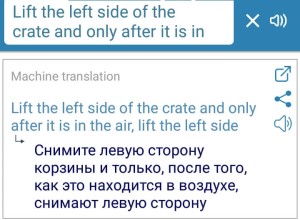
Accuracy: 1/10. Another blooper from Reverso. “Lift” is mistranslated. “It” is incoherent with “crate.”
Readability: 1/10.Unnecessary comma. Different forms of the Russian verb for “lift,” whereas they should be identical.
Performance comparison
Now, let’s compare performance between these three English to Russian language translator apps.
To calculate the final score, I used the formula below, assigning the importance factors of “2” to accuracy (more important) and “1” to readability.
((accuracy 1 + … + accuracy 7) × 2 + (readability 1 + … + readability 7) × 1) / 7

Yandex and Google came in very close. They got the same score for readability, but Google outperformed the competitor in the accuracy department.
That makes Google my go-to English to Russian translation app.
 I also feel that Google Translate is the best app in terms of usability.
Be alert, however, to its aggressive interpretation of the original text that led to omitting important words in two sentences out of seven.
Both Google and Yandex might also display different translations in the app and in the browser. With two of the examples, Yandex provided a second version that was worse than the one I had got a few days before.
Our runner-up, Yandex, might display incomprehensible translations. But if you adjust the source text a little bit, the translation may get better. It appears that Yandex may a times display a raw version of a translation first, without letting the more powerful AI technology to step in.
With a score that’s three times less than the leader has, Reverso trailed well behind. Its quality of translation is below average. However, one good reason to still use this app to translate from English into Russian is usage examples it conveniently provides.

Note about human translation services
We’ve seen that MT works well for simple sentences and has a hard time with specialized terms, creative text, and non-standard situations like errors in the original.
So, if you need something translated on the fly in order to understand the gist or communicate in an informal situation, reverting to Google for translation is your best option. The overall value it provides for these scenarios might be higher compared to professional translators: whereas quality is comparable, Google is immediately available, lightning-fast, and free.
Yes, an experienced translator might produce a better translation, but it’ll take time and money. The reason I made might “bold” is that finding a translator who’s able to produce high quality consistently is difficult.
However, for content that’s not carved out for free English to Russian online translators, you need professional translation services as Semantix points out. Here’s why:
- Even one word translated inaccurately can change the entire meaning of a sentence. Machine translation is prone to such errors, because it can’t figure out nuances. It’s particular stumbling point is ambiguity. Imagine you need to translate a medical report for your child urgently—you just don’t want to take risks.
- Another reason to choose professional services over a translation app is readability. These apps have a hard time with creative texts, producing translations that may make sense, but sound so robotic that they can never help you meet the goals you pursue with this kind of texts. I’d never trust an app in the readability department for purposes such as marketing or securing new business.
- Also, if your text is in a format that an app can’t handle, such as a scanned PDF, you can engage a professional translator who will not only translate the actual text, but also re-create the original formatting.
- Remember that you have an option of having a translation produced by Google revised by a Russian-speaking proofreader to ensure its quality meets your expectations.
[vc_row][vc_column width=»1/1″][sc_calltoaction title=»» subtitle=»Contact us for a free consultation about English to Russian translation» button=»1″ button_link=»url:http%3A%2F%2Fwww.velior.ru%2Fcontact-us|title:Yes,%20I%20want%20a%20free%20advice||»][/vc_column][/vc_row]
Did you add a »period» or »full stop» to any of the input sentences in Google Translate? Doing that sometimes changes the accuracy of the output.
Donny, thank you for your comment.
I did use a period in some of the cases. I believe that the output was accurate enough.
I assume adding a period when it was missing wouldn’t really change the output.
I highly recommend adding DeepL to the mix. It already is considered to be better than google, yandex or anything else out there. But I can’t tell the quality of Russian. 🙂 https://www.deepl.com/translator Here’s something about their quality, but that’s from 2017. So must be even better now that they collaborate with Linguee 🙂 https://www.deepl.com/en/quality.html
Thanks for the comparison, really a great job. Now it’s 2020, I hope to see an update for the progress and improvement of both translators.
Your article helped me a lot, is there any more related content? Thanks!
Thank you for your sharing. I am worried that I lack creative ideas. It is your article that makes me full of hope. Thank you. But, I have a question, can you help me?
Yandex имеет реальное преимущество для русского языка именно потому, что языковые нюансы и идиомы встроены глубже за счёт ориентации на русскоязычную аудиторию. Для технических или юридических текстов всё равно стоит проверять результат у носителя, поскольку контекстные ошибки машинного перевода часто незаметны на первый взгляд.
Yandex genuinely handles Russian idioms and colloquial expressions better than Google in many cases makes sense given Russian sits at the core of their entire business model. For technical or legal documents though, all three tools still need human review before any professional use.
vbdfcgbdcgbbg
This is actually a very detailed comparison of translation tools, especially between Google, Yandex, and Reverso. I like how it doesn’t just focus on simple sentences but also tests technical and medical examples, which really shows where machine translation still struggles. The scoring system makes the evaluation easier to follow, although in some parts the analysis feels a bit too long and repetitive.
Thanks for sharing. I read many of your blog posts, cool, your blog is very good.
Interesting comparison, but i think the results also depend a lot on what kind of text you’re translating. I mostly translate emails and small docs, and Google works fine, but for technical manuals it sometimes gives really odd wording. Never really used Reverso much, maybe because i didnt know it was more focused on learning. One thing i was looking for here was how these apps deal with slang or modern expressions, that would be nice to compare too. Just my experiance anyway.
I was a bit surprised that DeepL wasn’t included in the comparison. I know its Russian support has changed over time, so it would’ve been interesting to see where it stands against Google and Yandex now. Also, maybe adding one or two everyday conversation examples (not only technical ones) could help people who just need a translator for daily use.
Yandex Translate stands out as a strong option for English to Russian translations, especially with its focus on the Russian language. Comparing it with Google and Reverso helps users understand each app’s strengths, while the tips on avoiding common machine translation mistakes make the review even more practical.
This review offers a helpful comparison of popular English to Russian translator apps. It explains their features, strengths, and limitations in a simple way. A useful resource for anyone looking for reliable translation tools for learning or communication.
The comparison shows how translation tools have evolved and where they still need improvement. While apps can be helpful for quick communication, accuracy and human understanding remain important for complex content. Choosing the right tool depends on the purpose, language difficulty, and level of precision required.
This review gives a useful comparison of popular English to Russian translator apps. The discussion about Yandex and Google Translate features, along with the advice on machine translation limitations, helps readers choose the right tool while understanding the importance of accuracy in language conversion.
I found this comparison very helpful because it explains the strengths and weaknesses of each translation app with real examples. The accuracy ratings and practical observations make it much easier to choose the right tool for English to Russian translations depending on the situation.
The detailed testing approach with different sentence types, especially technical and medical examples, provides valuable insight into the strengths and limitations of machine translation. It’s a great reminder that while AI translation tools are becoming more powerful, human expertise is still essential for accuracy, context, and professional-quality translations.
Yandex offers a wide range of digital services and stands out for its strong focus on the Russian language market. Its translation tools provide convenient online and offline solutions, making it a useful option for accurate Russian language conversions and everyday communication needs.
thanks for sharing this information, the details translation make a easy to understand how Revrso translation perform compare to google translation.making it a trustworthy resource for language users.
Important information for anyone needing english to russian translation support, even a reliable translation tool makes communication easier for travelers, businesses, students, and professionals working,language tools like this, make communication and learning much easier !
This comparison gives a detailed look at how different translation tools perform beyond simple word conversion. I like that the article tests various sentence types because real-world translation often involves technical terms, context, and hidden meanings. It also shows that machine translation can be useful for quick understanding but still needs human review for important documents. The examples make it easier to understand why accuracy and readability both matter when choosing a translation method.
Reverso stands out as a useful language tool that goes beyond simple translation by offering word learning features and real-world examples. While it may not match major platforms, its dictionary functions and app accessibility make it a valuable choice for improving language skills.
A helpful comparison of English-to-Russian translator apps, showing how tools like Google, Yandex, and Reverso perform in different translation scenarios. It highlights the importance of choosing the right platform while understanding that context and accuracy still require careful review.
This review offers a helpful overview of English-to-Russian translation applications. The comparison between Yandex, Google Translate, and Reverso highlights their advantages, limitations, and accuracy levels, helping users select the most suitable tool for translation needs and improving language skills.
Yandex offers a comprehensive range of digital services with a strong focus on Russian-speaking users. Its expertise in the Russian language makes its translation tools valuable for accurate communication. The Yandex.Translate app also provides convenient online and offline translation options for users worldwide.
This review gives a clear and practical comparison of popular translation tools. I liked how the author tested each app with real examples instead of just describing features. The insights about machine translation mistakes are useful, especially for people relying on these tools for professional communication.
Your article provides valuable information, and your writing quality makes the content more enjoyable to read. The comparison of different English-to-Russian translator apps is detailed and helpful, giving readers a clear understanding of their features, accuracy, and practical uses for language translation needs.
Good article on English-to-Russian translation tools, need for accurate translation tools continues to grow for travellers, businesses, students, and professionals, as translation apps are becoming important tools for easier communication between different languages,thanks for sharing this useful guide!
Read this article for new information. It discusses creating an English-to-Russian translator. It contains a wealth of information, and I enjoyed reading it. Thank you very much for such excellent information.
I appreciate how the article tests each app with different levels of complexity instead of only looking at simple phrases. The examples clearly show that machine translation has improved greatly, but human review is still important for technical, medical, and creative content where accuracy and context matter.
This is an excellent blog. It includes a Russian translator app that makes translating from English to Russian very easy. I read the entire blog and really liked it. Thank you very much.
We are talking about a Russian app that translates from English to Russian. The main objective of this article is to inform people about the idea behind this blog. It is an excellent concept and also serves as good promotion for their app.
This comparison provides a clear look at different translation applications and their performance. I enjoyed reading how each tool was tested with real examples, making it easier to understand their advantages and limitations. The detailed explanation offers helpful guidance for language users.
Reverso provides more than simple translation by helping users learn vocabulary and understand language context through real examples. While it may not match larger platforms in computing power, its practical features make it a valuable language-learning tool.
Learning a new language or communicating across different cultures becomes much easier when you have access to reliable translation tools,language tools like these make communication, travel and learning much more convenient,thank you for sharing such a useful resource for anyone interested in english-russian communication!
Great comparison! I liked that you didn’t just declare a winner you actually tested each translator with increasingly difficult examples and explained why certain translations failed,medical and technical sentences really shows where machine translation can still be risky, even when the output sounds natural!
I encourage how you tested each platform with different types of sentences instead of only looking at simple examples, interesting to see how different translation apps perform with real examples,so this article shows shows why accuracy and context matter when choosing an english to russian translation tool!
Reverso stands out by combining translation with language learning through real-world examples, making it useful for learners. While it may not match Google or Yandex in computing power, it still delivers reliable translations and valuable contextual understanding.
Yandex stands out as a strong technology company with services tailored to Russian-speaking users. Its deep understanding of the Russian language could give it an advantage in machine translation, particularly for accurate Russian-to-other-language and other-language-to-Russian translations.
A useful overview for comparing free translation tools. The section on Yandex Translate is particularly interesting, especially for Russian language users. The practical tips about machine translation also highlight why accuracy and context matter.
The comparison makes a good point about how translation quality can change a lot depending on the type of sentence. Simple everyday phrases are one thing, but medical or technical wording is a totally different challenge. I also found the examples where the apps produced readable sentences with the wrong meaning pretty interesting, because that can be more dangerous than an obviously bad translation. For important documents, having a Russian-speaking person review the result still seems like a sensible step, even when machine translation saves alot of time.